
Sleep and Emotional Wellbeing: Why You Can't Just Power Through
If you’ve ever said “I’ll catch up on sleep this weekend” for the fifth week in a row, this one’s for you.
College, early jobs, group chats popping off at 1 a.m.—it’s easy to treat sleep like an optional bonus level. But your brain doesn’t see it that way. It treats sleep like water. When it doesn’t get enough, everything in your emotional world starts to crack.
This isn’t about “go to bed at 10 p.m. and wake up at 6 a.m. and drink lemon water.” It’s about understanding why sleep hits your anxiety, low mood, ADHD focus, and overall wellbeing so hard—and what to do when you literally feel like you can’t just “sleep more.”
Key Takeaways:
✓ Sleep isn’t a luxury—chronic sleep deprivation can mimic or worsen emotional challenges like anxiety, irritability, and low mood
✓ Teens and young adults who get healthier sleep tend to report fewer difficult feelings and better overall emotional health
✓ You don’t have to fix your whole sleep schedule at once—tiny, repeatable tweaks (like a 10‑minute wind-down) matter more than a perfect routine
✓ ADHD, anxiety, and late-night scrolling make sleep harder—but you can design sleep habits that work with your brain, not against it
✓ If you’re struggling, sleep changes can be one layer of support alongside things like counseling, peer support, and gentle self-care tools
1. Why sleep hits your feelings so hard
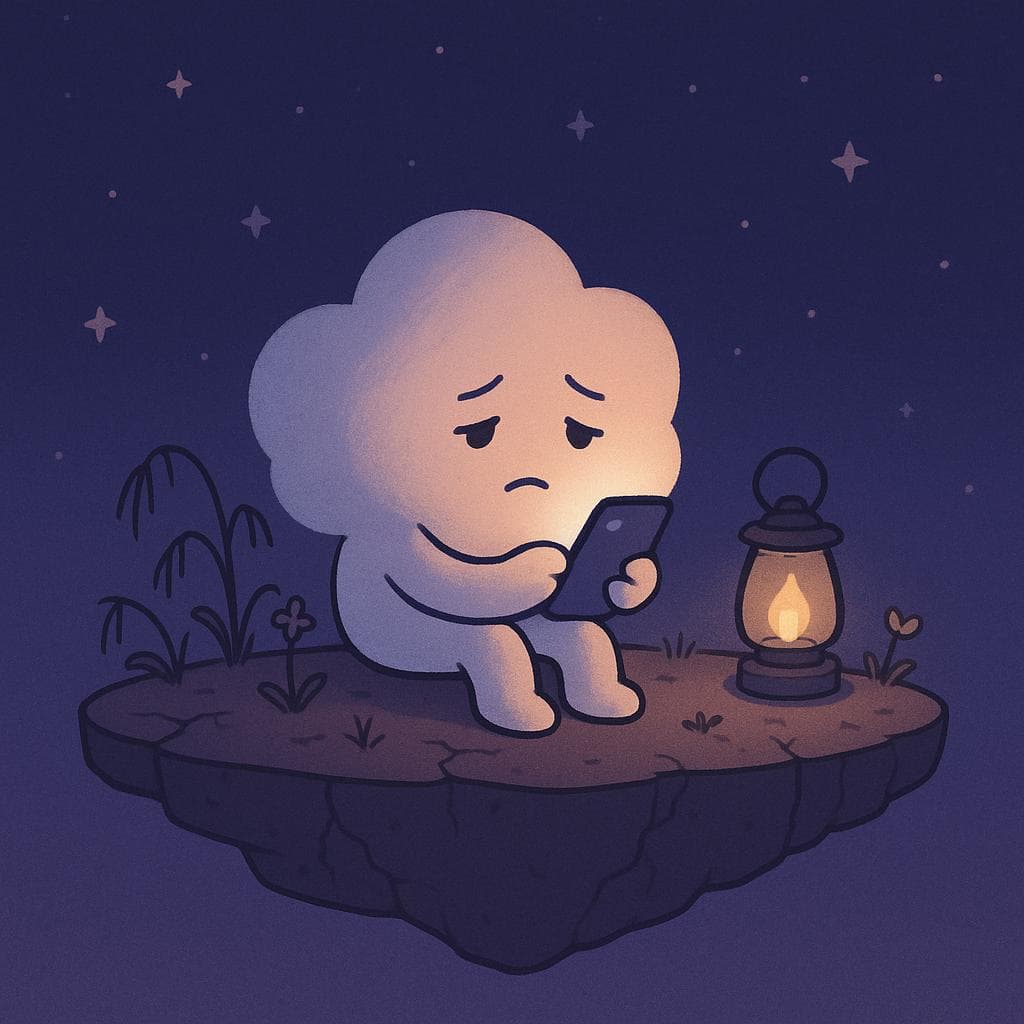
You’ve probably noticed this: one bad night and suddenly everything feels louder.
A small comment from a classmate stings more. A confusing email from a professor feels like proof you’re failing. Your brain spins faster, and tiny problems feel like proof your whole life is off track.
That’s not you being “dramatic.” That’s what happens when your nervous system is running on fumes.
What lack of sleep does
When you’re short on sleep, your brain:
- Has a harder time regulating emotions
- Reacts more strongly to stress
- Struggles to focus, remember, and plan
- Craves quick dopamine hits (scrolling, snacking, procrastinating)
Research backs this up: chronic sleep deprivation in teens is linked to more mood swings, irritability, and emotional reactivity, and can even mimic or worsen emotional conditions (National Sleep Foundation, 2024). In other words, being exhausted can look and feel like your anxiety or low mood is getting worse.
On the flip side, teens who earn a high grade on healthy sleep behaviours are much more likely to be free of significant low mood symptoms (National Sleep Foundation, 2024). Sleep isn’t a magic cure—but it’s a major “lever” for your emotional health.
Why “powering through” backfires
When you “push through” tiredness with caffeine, late-night cramming, or endless scrolling, your body goes into survival mode. You might get the assignment done, but you pay for it with:
- Extra anxiety the next day
- Brain fog in class or at work
- Zero energy for basic self-care
- More doom-y thoughts about yourself and your future
Over time, this can feed a rough cycle:
| Step | What Happens | How It Feels |
|---|---|---|
| 1 | Stay up late to catch up | “I have to finish this” |
| 2 | Sleep badly or too little | Restless, wired, exhausted |
| 3 | Next day feels awful | Irritable, anxious, low energy |
| 4 | Fall behind more | “I’m failing; I’ll fix it tonight” |
| 5 | Repeat | Burnout, hopelessness, shutdown |
You’re not failing at life; you’re stuck in a system that rewards overwork and ignores rest. No wonder your brain is tired.
In summary: Sleep is not just “rest.” It’s the base layer that supports your mood, focus, and ability to handle stress. When it’s off, everything else feels harder.
2. Why sleep is so hard right now
If you know sleep matters but still can’t get yourself to bed, you’re not alone—and you’re not broken. There are real reasons this is hard, especially for Gen Z and college students.
The anxiety + sleep loop
Anxiety and sleep have a messy relationship. Anxiety makes it hard to fall asleep; not sleeping makes anxiety worse.
National data show that nearly 1 in 5 adolescents report recent anxiety symptoms (CDC, 2025). Anxiety is now the most common diagnosed condition in U.S. adolescents (about 16%) (HRSA/NIH, 2024). You’re not imagining it—this is a lot of people whose brains are wired to stay “on,” especially at night.
Common patterns:
- Racing thoughts as soon as you lie down
- Replaying conversations from the day
- Imagining worst-case scenarios about school, money, or the future
- Feeling a spike of anxiety about not sleeping (“If I don’t sleep, tomorrow will be ruined”)
Your body gets the message: “We’re not safe. Stay awake.”
ADHD, late nights, and “revenge bedtime procrastination”
If you have ADHD or ADHD-ish traits, nights can feel like your only “free time” when no one is emailing, texting, or asking for things. Your brain finally wakes up—just when you’re “supposed” to sleep.
You might notice:
- Hyperfocus on games, shows, or deep dives at 1 a.m.
- Telling yourself “just one more episode” until it’s 3 a.m.
- Feeling physically tired but mentally wired
- Using late nights to reclaim control after a day that felt chaotic
This is sometimes called “revenge bedtime procrastination”—staying up late to get back time you felt you lost. It makes sense emotionally, but it taxes your body.
Social media and blue light
According to Pew, nearly half of U.S. teens say they are online “almost constantly” (Pew Research Center, 2024). A 2024 APA survey found that 37% of teens spend five or more hours a day on social media, and heavy users report worse wellbeing than light users (APA, 2024).
More time online doesn’t automatically equal bad sleep—but late-night scrolling does a few things:
- Keeps your brain in “compare and worry” mode
- Exposes you to blue light that tells your brain it’s daytime
- Makes it easy to lose track of time (“Wait, how is it 2:17 a.m.?”)
And research suggests that teens with more than three hours a day on social media have roughly double the risk of experiencing emotional challenges like anxiety and low mood (U.S. Surgeon General, 2025). Again: not your fault, but it is a factor.
In summary: Anxiety, ADHD, social media, and life stress all gang up on your sleep. You’re not lazy for struggling with it—your environment and brain wiring make it genuinely harder.
3. Tiny sleep shifts that actually help
You don’t need a 2‑hour nighttime routine with yoga, journaling, and herbal tea. When you’re exhausted, that’s just more pressure.
Instead, think in tiny shifts—1–5 minute changes that gently nudge your body toward rest.
Step 1: Create a “bare minimum” wind-down
Pick one small thing that means “we’re slowing down now.”
Some ideas:
-
Change the lighting
- Turn off overhead lights
- Turn on a lamp or string lights
- Dim your phone brightness
You’re telling your brain: “Sunset is happening, even if it’s 1 a.m.”
-
Do a 60‑second body reset
- Sit or lie down
- Inhale for 4 seconds, exhale for 6
- Repeat 5–8 breaths
Longer exhales help your nervous system shift out of “fight or flight.” It won’t erase anxiety, but it can turn the volume down a notch.
-
Pick a “last scroll” time
Instead of “no phone after 9” (lol), try:
- “I’ll do my last social media check 20 minutes before I want to sleep.”
- Set a simple alarm: “Last scroll, then wind-down.”
Even a 15–20 minute gap between intense scrolling and sleep can help your brain settle.
Step 2: Make falling asleep less pressure-y
If you’ve ever stared at the ceiling thinking “sleep, sleep, SLEEP,” you know how that goes.
Try shifting the goal from “fall asleep” to “rest.”
Example:
“I don’t have to fall asleep right now. My only job is to lie here and let my body rest. Even if my brain is noisy, I’m still resting.”
You could:
- Listen to a low-stimulation podcast or audio (no true crime, please)
- Do a simple body scan: notice your toes, then feet, then legs, slowly upward
- Count backwards from 300 by 3s—not as a test, just as something mildly boring
The point is to give your brain something gentle to focus on so it doesn’t spiral as hard.
Step 3: Anchor one tiny morning habit
Better nights often start with how you treat your mornings. Not a 5 a.m. miracle routine—just one small anchor.
Some options:
- Open your curtains as soon as you stand up
- Step outside (balcony, porch, outside your dorm) for 2 minutes of daylight
- Drink a glass of water before checking your phone
Teens with better sleep patterns tend to report fewer low mood symptoms (National Sleep Foundation, 2024). Light exposure early in the day helps reset your body clock so sleep later becomes a bit easier. If you want more ideas, we go deeper on this in our guide to building a wellbeing routine that actually sticks.
Step 4: Plan for “bad sleep” days
You will have nights where sleep just doesn’t happen. Instead of pretending that won’t occur, plan for it.
Make a tiny “low sleep” plan:
- One task you’ll prioritize (“If I sleep 3 hours, my only must-do is emailing my professor.”)
- One way you’ll be kinder to yourself (ordering food, asking a roommate for help, taking a shorter day)
- One thing you’ll skip (extra workout, extra study session, social event)
This shifts the vibe from “I’m doomed” to “I have a backup script.”
In summary: You don’t need to overhaul everything. One or two repeatable actions at night and in the morning can slowly reset your system.
4. Sleep, low mood, and anxiety
Sleep and emotional wellbeing are deeply tangled. When one is off, the other usually is too.
How low mood and sleep interact
Low mood can show up as:
- Sleeping way more than usual or barely at all
- Waking up feeling un-rested no matter how long you slept
- Zero motivation to get out of bed
- Feeling heavy and stuck, especially in the mornings
Research shows that teens with minimal or no depressive symptoms sleep significantly longer on school nights (around 7.4 hours) than teens with more severe symptoms (Saravanan et al., 2024). Nearly seven in ten teens who are dissatisfied with their sleep report elevated low mood symptoms (National Sleep Foundation, 2024).
Again: this doesn’t mean “if you just sleep, you won’t feel sad.” It means that tending to sleep is one concrete way to support your mood, especially when everything feels foggy.
How anxiety and sleep interact
Untreated anxiety in Gen Z is linked to academic decline, sleep disturbance, and increased risk of substance use (Parents Magazine, 2025). Sleep disturbance is literally part of what anxiety does to your body.
Common patterns:
- You wake up at 3 a.m. with your heart racing
- You dream about school, work, or arguments
- You dread bedtime because you know your brain will start spinning
This is where simple CBT-style tools can help. CBT (cognitive behavioural therapy) has strong evidence for treating youth anxiety (Sigurvinsdóttir et al., 2020), and digital CBT-based anxiety tools also show significant effectiveness (Csirmaz et al., 2024).
You don’t need full therapy skills to borrow some basics at night:
- Name the thought: “I’m thinking ‘Tomorrow will be ruined if I don’t sleep.’”
- Question it: “Has that always been true? Have I survived tired days before?”
- Soften it: “Tomorrow might be harder if I don’t sleep, but I’ve handled hard days before. I can still take care of myself.”
For more DIY CBT approaches, you can check out our guide on CBT techniques you can practice on your own.
In summary: Sleep, low mood, and anxiety form a feedback loop. You don’t have to fix all three. Nudging even one part—like your sleep habits—can start shifting the whole system.
5. Making sleep changes actually stick
Knowing what helps and actually doing it are two different games—especially with ADHD, anxiety, or burnout in the mix.
Here’s how to make sleep care feel more like tending a small plant, and less like forcing yourself into a bootcamp.
Start with “maintenance mode”
When you’re overwhelmed, aiming for “optimal sleep” can backfire. Instead, aim for maintenance mode:
- Not perfect
- Not aesthetic
- Just “good enough” to keep you going
For sleep, maintenance mode might look like:
- Going to bed within a 60–90 minute window most nights (not the exact same time)
- Doing one wind-down habit, not five
- Accepting that some nights will still be rough—and that doesn’t mean you failed
Use external supports, not willpower
Your brain is already tired. Let tools and systems do some of the work.
You could:
-
Visual reminders
- Sticky note near your bed: “Dim lights at 11?”
- A note on your laptop: “Last scroll by 12:30?”
-
Gentle alarms
- One alarm for “start closing tabs”
- One alarm for “brush teeth + lights down”
✅ Gentle label: “Future you will be so grateful for 20 more minutes of sleep.”
❌ Shaming label: “Why are you still awake??” -
Tracking tiny wins
Instead of tracking “8 hours of sleep,” track things like:
- “Dimmed lights before bed”
- “Stopped scrolling 15 minutes earlier”
- “Opened curtains within 10 minutes of waking up”
This is especially helpful if you’re using a habit tracker or wellness app—it gives you credit for effort, not perfection.
Layer sleep into things you already do
Sleep habits stick better when they’re attached to existing routines.
- After you plug in your phone → switch to warm display mode
- After you brush your teeth → do 3 slow breaths
- After you get into bed → play the same calming audio or playlist
You’re not inventing new tasks; you’re slightly editing ones you already have.
When to consider extra support
Sometimes, no matter what you try, your sleep and mood stay rough for weeks. You might notice:
- Constant exhaustion even with long sleep
- Ongoing low mood, irritability, or hopelessness
- Major changes in appetite, energy, or interest in things you used to enjoy
- Sleep struggles that make school, work, or relationships really hard to manage
You deserve support with that. Many young adults never get the help they need—about 20% of U.S. adolescents report unmet emotional care needs in the past year (CDC, 2025), and there’s often an 11‑year delay between first symptoms and first treatment contact (Wang et al., 2004; APA summaries, 2024).
If you have access, reaching out to a campus counselor, primary care doctor, or trusted adult can be a powerful next step. If you can’t afford therapy or don’t have insurance, you still have options—sliding-scale clinics, peer groups, online resources, and gentle tools like journaling and wellness apps can all be part of your support system. Our post on making the most of campus counseling services breaks this down more.
6. Conclusion: You don’t have to earn your rest
You’ve been taught that grinding, hustling, and “powering through” are signs of strength. But your brain and body don’t care about that narrative. They care whether you’re getting enough of the basics: sleep, food, movement, connection.
Sleep is one of the quietest forms of self-respect you can practice. Not as a reward for finishing everything, but as a baseline need—like watering a plant even when it hasn’t bloomed yet.
If you do nothing else after reading this, try this one tiny step tonight:
- Pick one 1–5 minute wind-down habit
- Attach it to something you already do
- Repeat it for a few nights, even imperfectly
That’s it. No full routine. Just one seed.
Over time, those small, repeated choices can turn into a soft structure that holds you up when everything else feels chaotic. You don’t have to fix your whole life to deserve better sleep. You can start where you are, with what you have, tonight.
If you want a gentle place to track these tiny sleep wins and see them grow over time, Melo Cares can help you tend to yourself one small action at a time.
This article is for general information and support only and isn’t a substitute for professional care. If your sleep or emotions have been difficult for a while, consider reaching out to a counselor, doctor, or trusted support person for more personalized help.
